


To help people understand where they are in line for the vaccines and what to do when it’s their turn, The Oaklandside reached out to the county, hospitals, and clinics for answers.
Our focus here is vaccine distribution, not vaccine safety, but NPR recently answered questions about what’s safe for pregnant women and children. The Associated Press shed light on rare allergic reactions, but reminds us that the FDA, the federal agency that approves safe medical supplies, has found no serious side effects in clinical trials. Health officials continue to monitor vaccinated individuals.
The Oaklandside has also talked to healthcare workers and emergency providers about why they’re getting vaccinated, and what the vaccines mean for Oakland, which has been the hardest hit in Alameda County.
We’ll keep this guide updated as more information arrives, and will work to answer more questions about reaching non-English speakers, what kinds of questions you can expect at a vaccination appointment, and more.
Jump to an answer
How many vaccines have arrived in Alameda County?
Who has already gotten vaccinated?
How many vaccines will Alameda County need to reach herd immunity?
Who decides the order of vaccinations?
Who is in charge of distributing vaccines?
Can I choose which brand of vaccine to take?
I’m undocumented. Will I be able to get vaccinated?
How will unhoused people get vaccinated?
How is the county making sure vaccines are distributed equitably?
How many vaccines have arrived in Alameda County?
The two vaccines that have been approved for emergency use in the U.S. so far, developed by Pfizer-BioNTech and Moderna, both require two doses each. Each has different waiting periods between each dose. The Pfizer-BioNTech vaccine has a waiting period of 21 days, and the Moderna vaccine has a waiting period of 28 days.
So far, the county has received 53,000 first doses of Pfizer-BioNTech and Moderna and a little over 32,000 second doses. The first doses were administered in mid-December.
First-round doses have been distributed by the county to some hospitals and other healthcare facilities, like long-term care centers. A little over 11,000 doses have been distributed to county-operated PODs, temporary locations that give out medications during a public health emergency. The PODs are currently being used to vaccinate healthcare workers and first responders.
Who has already gotten vaccinated?
The first vaccines went to acute-care hospitals and 911 first responders. Alameda County is still in Phase 1a (see the table below to see who falls under this category). Most people in this group are healthcare workers.
“The state has asked us first to use those doses with healthcare workers and then in skilled nursing facilities, so that there’s still an intact healthcare system to take care of us,” said Dr. Kathleen Clanon at a virtual town hall organized last week by Congresswoman Barbara Lee. Clanon is the Medical Director of Alameda County Health Care Services Agency.
“We figure it’s going to take us a couple more weeks to get through all the healthcare workers,” added Dr. Clanon.
As of last week, 79% of Oakland Fire Department personnel—that’s 338 people—have received the Pfizer-BioNTech vaccine, said OFD spokesperson Michael Hunt. Some have already gotten their second dose.
Who will get vaccinated next?

On Wednesday, California announced that people aged 65 and older have been added to the next phase of vaccinations. Previously, the next phase was limited to people aged 75 and older.
According to county health officials, Phase 1 will likely last until spring. Ultimately, it depends on how many vaccines the county has on hand at any given moment. The county can’t skip phases, and vaccine providers could face severe consequences if they vaccinate out of order, including losing their medical licenses.
For details on how “essential workers” are defined, look up an occupation here.
How many vaccines will Alameda County need to reach herd immunity?
Many public health experts agree that herd immunity—where the virus can’t easily spread through a community because enough people are immune to it—is an important next step towards overcoming the pandemic. One way of achieving this is by vaccinating as many people as possible.
Aneeka Chaudhry, a director with the county health agency, recently said that “as high as 80 to 90% of the population in Alameda County” would need to be vaccinated in order to achieve herd immunity.
Who decides the order of vaccinations?
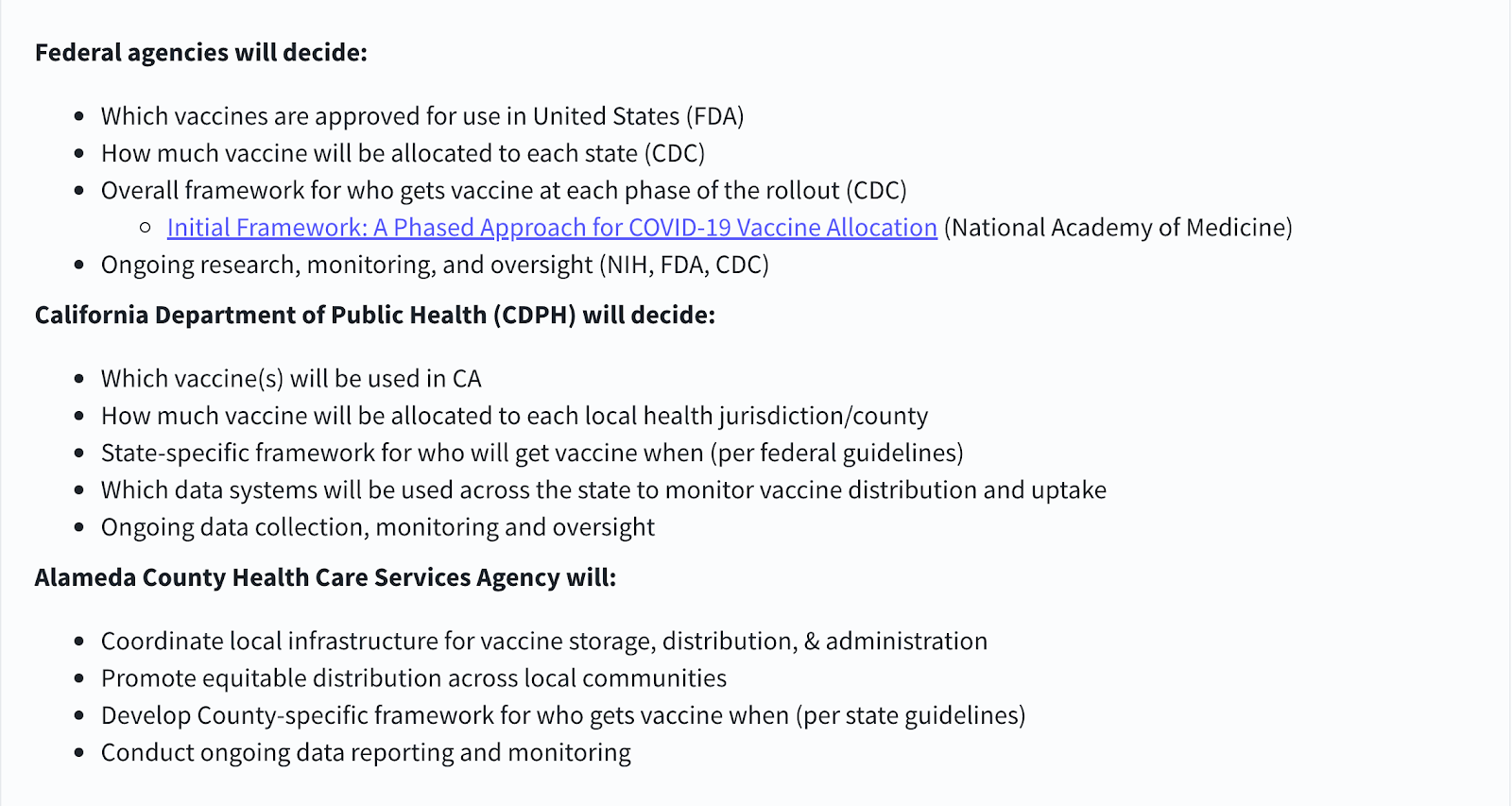
The county is administering vaccines based on the state’s prioritization framework, which follows the Centers for Disease Control and Prevention’s recommendations. Vaccines are distributed in an order based on what kind of work you do, your risk of exposure to COVID-19, and then your age and underlying medical conditions.
The federal government, state government, and local public health agencies all work together to roll out the vaccines. The chart below, from Alameda County’s FAQ page, breaks down what each agency does.
Who is in charge of distributing vaccines?
The county health department makes the final decision about when different groups of people will get the vaccine. It’s also responsible for carrying out the state’s plan, and for coordinating each phase of vaccine distribution.
A countywide community vaccine advisory group, which had its first meeting on Dec. 21, provides the county with input on distribution and prioritization, as well as ideas about how to communicate about the vaccine and combat misinformation.
How will people be notified that they’re eligible for a vaccine?
The county released two sign-up forms this week for residents and employers to express interest in being notified when they’re eligible for the vaccine.
The form asks for basic information, like your name, age, zip code, insurance provider, and contact information. The Alameda County Public Health Department will reach out to you when it’s your turn to get vaccinated.
According to Dr. Kathleen Clanon, the county will advertise these sign-up forms “on as many different platforms as we can, in the newspaper and on the radio and everything else.” The county will also have a telephone number for people to sign up.
In case the county’s system becomes overwhelmed —like it did on Wednesday, leading to the form becoming inaccessible—the state announced that it’s releasing its own, similar system. This system should be launched next week, and then will be used to help counties and cities run mass public vaccination events.
How is eligibility proven?
According to county spokesperson Neetu Balram, people will need to provide photo identification, registration confirmation, and employment verification, like a pay stub, work badge, or employer list, at vaccination appointments.
“We recognize ID could be a barrier to getting vaccinated as we move along in the phases, so we are reviewing how else we can ask individuals to attest that they are in the phase that is being vaccinated and not jumping the line,” said Balram.
The county also acknowledged the challenge of verifying people with high-risk conditions and has not yet determined how they will handle those cases.
Is it free to get vaccinated?
Vaccinations are free for all, including people who do not have medical insurance. Vaccine providers can recoup fees from private and public insurance companies, and from a government fund for people without insurance, according to the CDC.
Can I choose which brand of vaccine to take?
Not at this time. Currently, people will be vaccinated with either the Moderna or Pfizer-BioNTech doses, depending on the supply. Both your first and second doses will deliver the same vaccine.
I’m undocumented. Will I be able to get vaccinated?
You won’t need to be a U.S. citizen to receive the vaccine, per the county’s FAQ page.
How will unhoused people get vaccinated?
The county will lean on its street medicine program to vaccinate unsheltered and unhoused people where they are located. “The tough part is folks not living in a large encampment, but tucked away in one or two tents,” said Dr. Kathleen Clanon.
Where will I get the vaccine?
According to the county’s FAQ page, vaccines will be given at hospitals, clinics, private practices, pharmacies, and “community-based points of distribution,” or PODs. In the past, PODs have been set up at St. Rose Hospital in Hayward and Castro Valley Library. Future sites will include the Lake Merritt BART station.
The county’s community vaccine advisory group is also discussing opening school sites for vaccinations, and mobile testing options to travel to communities disproportionately impacted by the pandemic.
Vaccination sites must have refrigeration to store the vaccine. This currently prevents some otherwise accessible places, like St. Mary’s Center in West Oakland, from opening as a potential site.
Hospitals
Sutter Health says: “We plan to make appointments available very soon through My Health Online and a dedicated phone number. Sutter will hold vaccination clinics across the Bay and Valley Areas, where you can make an appointment when you become eligible. At this time, vaccines will not be scheduled nor administered in your provider’s office.” This is for Sutter patients only.
Kaiser is following state guidelines and currently has appointments for healthcare workers, long-term care patients and staff, and people 65 years and older. To make an appointment, call 866-454-8855 and request a vaccine. Your eligibility will be confirmed before an appointment is made. Kaiser recommends checking back on its website for updates and plans to offer a new online tool to schedule vaccination appointments. Kaiser does not have a waitlist or cancellation list.
Currently, the Kaiser hotline has wait times of two to four hours. An email sent to a Kaiser member stated: “Due to interest in the vaccine, the call center may have long wait times. We expect supplies to increase and more appointments to become available in the weeks to come. Even with a lot of supply, it will take many weeks for all patients over 65 to get their vaccine.”
Alameda Health System
According to a press release, AHS received a shipment of nearly 8,000 doses of the Pfizer-BioNTech vaccine and 1,400 Moderna doses in late December. AHS plans to vaccinate 200 patient-facing healthcare workers each day within the next few weeks at multiple hospitals.
After healthcare workers, the vaccines will be distributed to people living in long-term care facilities and then to essential workers before going out to the general public.
Walgreens and CVS Pharmacy
A Jan. 6 news release states that vaccines will eventually be available at all CVS pharmacies throughout the country, starting with seniors in New York and Indiana. CVS Pharmacy says it will have the capacity to administer 20 to 25 million shots a month. CVS will be offering the Pfizer-BioNTech vaccine in California.
Vaccines at CVS will be offered on an appointment-only basis on CVS.com or through the CVS Pharmacy app. 800 vaccinations will be reserved for people without internet access.
Walgreens is currently delivering vaccines to long-term care facilities. The company hasn’t announced a date that it will begin administering vaccines for the public.
Walgreens and CVS pharmacies have partnered with the federal government to vaccinate at senior living centers, skilled nursing facilities, and long-term care facilities. Email covax@acgov.org to check if your building is eligible. If not, the county will “get to the larger buildings that aren’t in that federal partnership over time,” said Dr. Kathleen Clanon, of the county’s public health department.
Other retail locations that have partnered with the federal government include Rite-Aid, Walmart, and Costco. See the entire list here.
University of California
U.C. Berkeley’s University Health Services announced on its website that the first shipment of Moderna vaccines was slated to arrive for use through the campus health system on Tuesday, Jan. 12. The plan is to vaccinate all Phase 1a U.C. Berkeley staff, students, and faculty who are interested within the next two weeks.
LifeLong Medical Care
According to Dr. Michael Stacey, chief medical officer at LifeLong and a physician consultant for the county health system, LifeLong will begin vaccinating in-home support services workers in Alameda County next week. Lifelong hasn’t received doses for the public yet. However, in Contra Costa County, LifeLong Medical expects to start vaccinating existing LifeLong patients who are 65 and older next week.
Alameda County has not yet determined exactly what role LifeLong and other community health centers will play in vaccinating people who are not already their patients. According to Stacey, LifeLong is ready to help however it can. “We are committed to utilizing any supply that we receive as quickly as possible, as we understand that vaccines in arms, not freezers, is the key to ending this pandemic,” he said.
Coliseum parking lot
The Coliseum Authority, the agency that manages the Coliseum stadium, discussed the possibility of opening the Coliseum parking lot as a mass vaccination site.
On Jan. 15, interim executive director Henry Gardner said he couldn’t think of a better way to use the Coliseum parking lot right now and that they should move full speed ahead. The Coliseum Authority formed a task force to plan the vaccination site.
How is the county making sure vaccines are distributed equitably?
The county says it is factoring in race and ethnicity, geography, socioeconomic factors, and critical populations, along with age and zip code.
Aneeka Chaudhry of the county health system said the state has been referring to the California Healthy Places Index as part of their equity measure for reopening. The index is an interactive tool that shows the impact of socioeconomic and environmental factors on public health.
The index shows stark health inequities in West Oakland and most of East Oakland. Because of this, the county could recommend prioritizing these neighborhoods.
Will the county track vaccinations on its COVID dashboard?
The county plans to create a vaccine dashboard with demographic data as it becomes available. “It would provide a snapshot of how many doses have been administered and which entities are administering them,” said county spokesperson Neetu Balram.
The county health department does “seem to be successfully tracking doses they receive and the doses they have delivered to county locations,” said Alameda Health System spokesperson Kate Preston. “They are also tracking county clinics and how many are being vaccinated. They have yet to get a tracking/reporting system in place for all hospitals in Alameda County.”
Useful links
FAQs page on Alameda County’s Department of Public Health website: answers questions from the community including: What do the vaccine phases mean for me? What should I do while I wait to be vaccinated? Should I get the vaccine if I have an allergic reaction to another vaccine?
Community Advisory Vaccine Group: an ad-hoc countywide group of doctors, nurses, childcare providers, disability advocates, public health officials, teachers, and church and community leaders. The group was created to share information about the COVID-19 vaccines, build trust with communities, and coordinate messaging about the vaccines. The group plans to meet bi-weekly through spring 2021. The next meeting is on Jan. 26 at 5:30 p.m. All meetings are open to the public.
CDPH Vaccine Allocation Guideline: the county is following the state’s department of public health recommendations for vaccine allocation.
Centers for Disease Control and Prevention (CDC) Guideline: “When Vaccine is Limited, Who Should Get Vaccinated First?” is the CDC’s page for vaccination prioritization. There’s an option to sign for email updates.
The post The COVID-19 vaccine rollout in Oakland: Your questions, answered appeared first on The Oaklandside.