

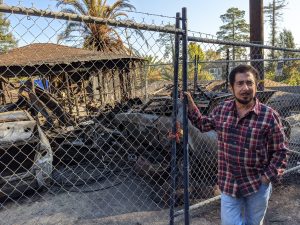

One week after a portable generator caught fire in his neighbor’s carport, starting a two-alarm blaze in the Oakland hills, Ronn Guidi and his housemate John Cunningham pulled up alongside their soot-blackened driveway. A new chain link fence separated Guidi’s lot from the street. Behind the fence, two burnt car husks sat in the driveway, windows obliterated, paint burned off, trunks gaping open. Beyond the auto ruins and the charred framework of what had been the garage, a blue tarp was spread over their home’s roof, covering a wide hole firefighters had chopped during the Oct. 27 blaze to vent smoke and heat.
The fire could have been worse. It spewed smoke and cinders into the dry morning air over Montclair’s thickly-settled Merriewood neighborhood, but firefighters were able to contain the damage to Guidi’s and his immediate neighbor’s homes. A third neighbor lost some trees and shrubs when flames leapt the street before being quickly extinguished.
“Seven months,” Guidi said, gazing at the tarp over his roof, answering a question no one had asked. “They say we’ll get back in the house in seven months.”
As Cunningham pulled empty plastic jugs from his car’s trunk to fill at a neighbor’s hose bib, Guidi, 84, founder of the Oakland Ballet Company and Oakland Ballet School, shoved his hands in his jeans pockets and surveyed the damage around his home.
“I think we’re going to lose that,” he observed, indicating a fire-desiccated pine near his front steps. “That one, too,” he added, pointing at a deeply singed palm. “But,” he said with a small smile, “we’re here to water the persimmon on the patio. I think that will survive.”
In addition to displacing Guidi and Cunningham in the midst of a pandemic, the fire took Guidi’s beloved pet birds—three aviaries filled with mynahs, turtle doves, and others—and charred his cherished garden.
The fire also claimed something of cultural significance to all of Oakland. It incinerated recordings of Oakland Ballet “Nutcracker” performances, and destroyed countless brightly-painted and costumed wooden nutcracker figurines, photos of dancers, and other memorabilia from Guidi’s long career as a ballet maker, teacher, and mentor. “We found a few old VHS recordings in a box,” Guidi said calmly, “but they were covered with soot and ash.”
Guidi founded OBC in 1965, helmed it until 2000, and came out of retirement briefly in 2007—at age 71—to salvage the company from bankruptcy. He earned international acclaim for Oakland with his powerful resurrections of almost-lost ballets from the early 20th-century Ballets Russes repertoire. He also created a much-loved annual “Nutcracker” performance that offered hundreds of young ballet students their first opportunity to perform alongside professionals. The event drew thousands to Oakland’s Paramount Theater for a holiday outing that, according to a San Francisco Chronicle review, packed “emotional wallop and kid-friendly charm.”
Among his friends and large extended family, though, Guidi is most famous for opening his home to people who, for various reasons, need shelter. “I have had many people who needed help come and live with me in this house,” Guidi said during an interview, resting a hand on the fence separating him from his burned garage. Cunningham is one of those people. His room and all his personal belongings were destroyed in the fire.
Could the blaze have been avoided?
The irony of the Merriewood fire is that it was started by a home generator in a wooded neighborhood where the electricity had been shut off by PG&E to decrease the risk of a fire breaking out due to strong winds. As these events—referred to as Public Safety Power Shutoffs (PSPS)—become more common, generator usage has also increased.
Catherine Wolfram, a professor of economic analysis and policy at U.C. Berkeley’s Haas School of Business, recently completed a survey of Californians’ responses to power outages. “I was surprised at how many new generator purchases and existing generators there were in our sample set,” she said. Fifteen percent of respondents reported owning a generator; an additional 12% had recently purchased one due to outages.
TJ Van Deusen, owner of the generator installation company Pacific Power, said Wolfram’s findings don’t surprise him. He founded his business a year ago as area demand for generators exploded. “Eighteen months ago there were only two local generator companies,” he said, “and now there are dozens. PG&E isn’t getting better fast, so generators will be in demand for years.”
While Wolfram’s survey was designed to understand the value Californians place on having uninterrupted electricity, it surfaced something else. In her words, “power outages lead to generator installations, which can lead to deaths.”
Master electrician Geoff Williams, who has run his business from Montclair Village for more than two decades, said generators are useful if they are installed, used, and maintained correctly. “But if you’re a do-it-yourself person without experience, or you hire a DIY guy to set you up…well, there are quite a few ways you could die, including fire, carbon monoxide poisoning, or electrocution if the generator isn’t grounded,” said Williams.
Wolfram is sympathetic to PG&E’s position on shutoffs. “Supplying electricity is hard when your lines run through dry California forests and the weather is hot and windy. And none of us want a future Paradise event,” she said, referring to the 2018 Camp Fire that killed 85 people and destroyed 19,000 structures in Butte County. However, she added, “that [Merriewood] generator fire demonstrates that there are costs to shutoffs. It’s important to say that this relationship—outages leading to more generators—is dangerous.”
Some generators are safer than others
As the Merriewood shutoff dragged into its third day last month, Guidi’s next-door neighbor fired up a borrowed portable generator in his freestanding carport to light his adjacent home. The generator fit into a category that Pacific Power’s Van Deusen calls “the least ideal solution.”
“There are three levels of generators,” Van Deusen said. “Level one, the least expensive and least safe, is a gas-powered portable—or propane-powered, which is a little safer—with an extension cord running into your house. That costs about $1,000, and you’re on your own in terms of servicing it. Level two is a portable generator that you have an electrician hardwire to your house. That costs about $5,000. And level three, the most ideal and safest, is a full standby generator that’s automatic, runs on natural gas, and is wired to the house by a professional installer, so that if the electricity goes out you’re on backup power within ten seconds. Those run around $10,000 to $15,000, and if they’re installed correctly, they’re really safe.”
But according to Van Deusen, steep slopes like those found in the Oakland hills may not provide enough room for a level three generator setup. Fixed generators must be installed minimally 18 inches away from any house and 5 feet from any door or window.
Guidi’s neighbor declined an interview request for this article. According to Oakland Fire Department spokesperson Michael Hunt, the generator the neighbor used was an older, gasoline-powered model, and age may have been a factor in its failure.
Like Guidi, the Merriewood neighborhood is demonstrating resilience. Residents have expressed gratitude that OFD responded to their calls quickly and strategically, and stayed for hours post-fire to quell potential flare-ups. Neighbors—some of whom broke rigorous quarantine routines to flee together down Montclair’s narrow, winding, potholed roads—have supported one another post-fire. Guidi’s nephew Brian Evans created a GoFundMe campaign the night of the fire, which topped its $30,000 goal within days.
But for Oakland hills neighbors who live in an area that has experienced deadly and devastating fires, the neighborhood’s experience is a cautionary tale. As “fire season” extends each year and PG&E struggles to improve the safety of its equipment, more people are likely to install and use generators.
“The use of generators in response to PSPS events will become more and more common,” said OFD’s Hunt. “Because of that, we have begun developing an aggressive PSA and safety education campaign to ensure that people who are using them know how to do so safely and lawfully.”
The post What we can learn from a recent house fire in the Oakland hills appeared first on The Oaklandside.